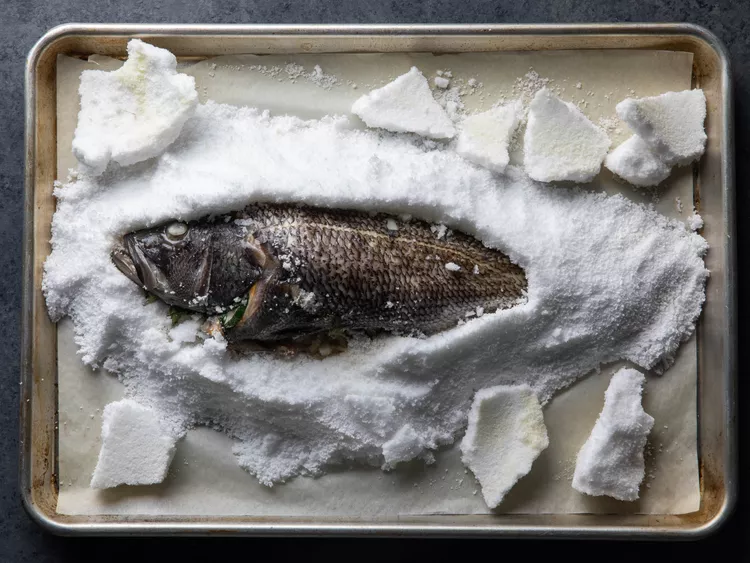
Salt-baked whole fish seals moisture inside a salt crust during roasting, producing meat that's juicier and more flavorful than conventionally roasted fish. Stuffing with lemon, garlic, and fresh herbs adds aromatic depth.
One 1- to 2-pound (450 to 910g) whole fish, such as bass, snapper, porgy, dorade, trout, or branzino, scaled and gutted
Lemon slices, peeled garlic cloves, peeled ginger slices, and/or fresh herb sprigs (such as parsley, dill, oregano, thyme, or tarragon), for stuffing
Extra-virgin olive oil, for brushing and drizzling
5 Ingredients
Delivery in as fast as one hour.*
Powered by
Prices vary by store
*Service fees apply. Instacart® and the Instacart logo are registered trademarks of Maplebear Inc. d/b/a Instacart.
Instructions
1
Preheat oven to 400°F (205°C) and set rack to middle position. Line a rimed baking sheet with parchment paper. In a large mixing bowl, stir together salt and water until thoroughly mixed and salt is damp but not soggy.
2
Stuff fish cavity with aromatics of your choice, then lightly brush olive oil all over the fish on both sides.
3
Spread about one-third of the salt mixture on the prepared baking sheet, covering an area just a little larger than the shape of the fish.
4
Set fish on salt bed. If using a leave-in probe thermometer, insert it into thickest part of fish (if using a regular instant-read thermometer, see next step).
5
Fully cover fish with the remaining salt, making sure to pack salt all around the fish in an even layer about 1/2 inch thick. If using an instant-read digital thermometer, insert the probe of the thermometer into the salt to form a narrow hole leading to the thickest part of the fish (you will use this hole after the salt hardens to access the fish and check its temperature). Roast fish until center of the thickest part of the flesh registers 130°F (55°C), about 20 minutes for a 1-pound fish and 30 minutes for a 2-pound fish. Let rest 5 minutes.
6
Using a knife, carefully cut into salt crust along the length of the fish on the side near its belly, then gently crack open salt to uncover fish. Being careful not to get the salt crust mixed into the flesh, remove and discard skin, then fillet the cooked fish and transfer to a platter. Serve.
Was this recipe helpful?
Tips & Notes
Pro tips
Mix kosher salt and water until it resembles wet sand; the moisture helps the crust hold together and cook evenly.
Stuff the cavity with herbs, lemon, and garlic before burying the fish—these infuse the meat as it steams inside the crust.
Check doneness by piercing the salt crust and testing the flesh near the backbone; it should be opaque and flake easily without resistance.
Let the salt crust cool slightly before cracking it open; this makes removal easier and prevents steam burns.
Substitutions
Any firm white fish (sea bass, snapper, halibut) → delicate fish (sole, flounder) — reduce cooking time by 5–10 minutes to avoid drying out.
Storage & make-ahead
Best served fresh and warm. Leftover salt-baked fish can be refrigerated up to 2 days and gently reheated in a 275°F oven until warmed through.
Common Questions
Why bake fish in salt instead of roasting it plain?
The salt crust insulates the fish and traps steam, preventing moisture loss during cooking. This results in tender, juicy flesh and more concentrated flavor compared to plain roasting.
What size whole fish works best for salt-baking?
Fish weighing 1 to 2 pounds are ideal. Smaller fish may overcook; larger fish may have uneven cooking. Bass, snapper, branzino, dorade, porgy, and trout are all excellent choices.
Can I use table salt or sea salt instead of kosher salt?
Kosher salt is preferred because its larger crystals mix better with water and create a more even crust. Table salt's finer grain can pack too densely; sea salt works but may be saltier by volume.
How do I know when the salt-baked fish is done?
The salt crust will harden and brown slightly. Insert a fork into the thickest part near the backbone—meat should be opaque and flake easily. Cooking time is typically 25–35 minutes at 400°F depending on fish size.
Is the salt crust edible or do I discard it?
Discard the crust entirely. Once baked, it's hard and inedible. The fish inside will not taste overly salty if cooked correctly.
Keep Cooking
One Pot Garlic Chicken Pasta
30 min
BEST Zuppa Toscana
40 min
Zuppa Toscana
55 min
Brandy Crusta
5 min
Chirashizushi
Antipasto Salad
10 min
Antipasto Pasta Salad with Italian Vinaigrette Dressing