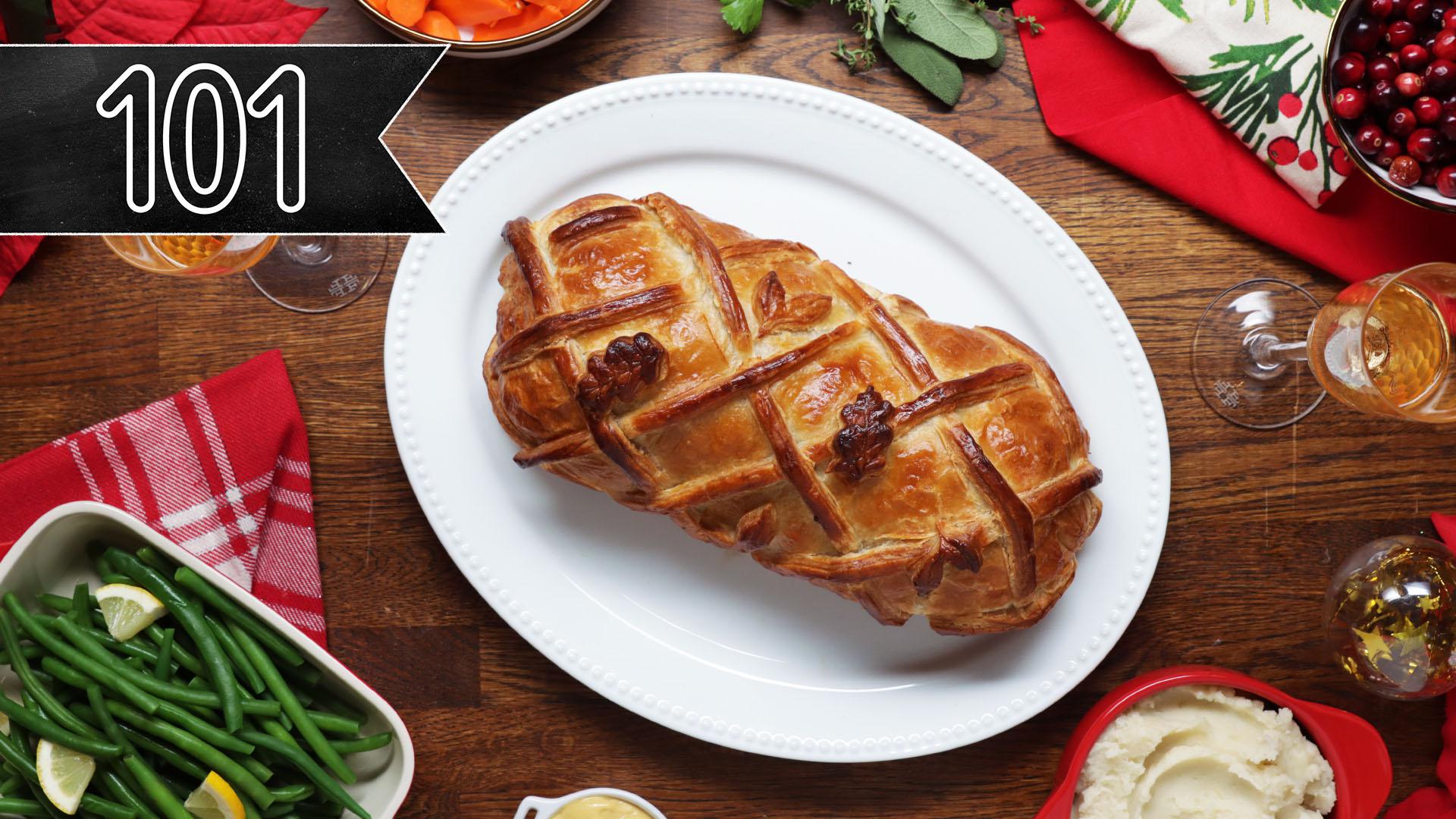
Beef Wellington is a show-stopping European dish pairing seared beef tenderloin with a savory mushroom duxelles and pastry crust. This recipe includes a time-saving hack for preparing the mushrooms.
Check what you already have. We'll leave it off your shopping list.
14 Ingredients
Powered by
Prices vary by store
*Service fees apply. Instacart® and the Instacart logo are registered trademarks of Maplebear Inc. d/b/a Instacart.
CookOS may earn a commission from Instacart orders.
Instructions
1
Preheat the oven to 300°F (150°C).
2
Add the mushrooms to the bowl of a food processor and pulse until finely diced, but not blended into a paste. Spread the mushrooms on a baking sheet in an even layer and transfer to the oven. Cook, stirring every 15 minutes, until the mushrooms have released their moisture and are dried out, about 45 minutes total.
3
Meanwhile, truss the tenderloin: Measure a piece of butcher’s twine 6 times the length of the tenderloin. Wrap the twine around one end of the loin and tie a knot to secure the string. Make a loop around your hand with the string and place over the loin about 1 inch down from the first knot. Continue looping the twine in 1-inch intervals until you reach the end, then tie the twine in a knot to secure (this helps the tenderloin hold its shape). Generously season the beef tenderloin with salt and black pepper.
4
Heat the vegetable oil in a large cast iron skillet over medium-high heat until shimmering. Place the seasoned tenderloin in the pan and sear quickly on all sides to lock in moisture, about 1 minute per side. Do not overcook; it’s fine if the meat does not have a golden brown crust.
5
Remove the pan from the heat and transfer the seared tenderloin to a small plate or baking sheet. Cut off the twine, then brush the tenderloin with the mustard to cover completely. Transfer to the refrigerator to cool, about 1 hour.
6
Return the pan to medium-low heat. Add the butter, shallots, and garlic and cook until the shallots have caramelized, about 5 minutes, stirring with a wooden spoon or heat-safe spatula to prevent from burning.
7
Deglaze the pan with the cognac, stirring to scrape up any browned bits from the bottom. Continue cooking until the alcohol has evaporated and the pan is mostly dry, about 1 minute. Add the dehydrated mushrooms and stir to incorporate. Season with salt to taste. Transfer the duxelles to a bowl and cover with plastic wrap, pressing directly against the surface. Transfer to the refrigerator to cool completely, about 45 minutes.
8
On a large sheet of plastic wrap, arrange the prosciutto in a large rectangle wide enough to cover the tenderloin, layering evenly. Spread the mushroom mixture evenly across the prosciutto, leaving a 1-inch border around the edges, and press down in a flat layer.
9
Place the tenderloin at the bottom of the mushroom mixture and use the plastic wrap to help roll the prosciutto and mushrooms around the tenderloin. The prosciutto should tightly and completely cover the tenderloin. Hold the ends of the plastic wrap and roll the log to help create a tight seal. Refrigerate the roll until chilled all the way through, about 1 hour.
10
Place a sheet of puff pastry on a lightly floured surface and roll out with a lightly floured rolling pin until the pastry sheet is large enough to cover the log.
11
Brush the top third of the puff pastry with beaten egg. Unwrap the log and place on the bottom third of the pastry, then roll up into a tight log, turning so the seal is at the bottom. Fold in the sides of the pastry and press under the log. Set the log on a large sheet of plastic wrap and roll to wrap tightly. Refrigerate again while the oven preheats.
12
Preheat the oven to 425°F (220°C). Line a baking sheet with parchment paper.
13
Unwrap the log and set on the prepared baking sheet. Brush the log all over with beaten egg, then use a paring knife to create a decorative pattern on the puff pastry. Alternatively, cut the second sheet of puff pastry into long strips and create a lattice over the Wellington, and/or cut out autumnal shapes and press them onto the log. Brush the log with more beaten egg.
14
Bake the Wellington until the puff pastry is a deep golden brown, 30–40 minutes. If the pastry is getting too dark before the beef is finished cooking, cover loosely with foil and continue cooking. The internal temperature of the beef should reach 125°F (52°C) for a medium-rare finish.
15
Remove the Wellington from the oven and let rest for 1 hour. The internal temperature will continue to rise to 135°F (57°C).
16
Slice the beef Wellington into 1-inch pieces and serve.
17
Enjoy!
Was this recipe helpful?
Tips & Notes
Pro tips
Sear the beef tenderloin on all sides in hot oil until deeply browned before assembling; this develops a crust that locks in moisture and prevents sogginess.
Cook the mushroom duxelles until completely dry—excess moisture is the main cause of soggy pastry; use the time-saving hack mentioned in the video.
Use a meat thermometer to check doneness; remove wellington from oven at 125°F for medium-rare, as carryover cooking will raise temperature by 5°F.
Let beef wellington rest for 10 minutes before slicing to redistribute juices and keep the interior tender.
Substitutions
Beef tenderloin → beef filet mignon (same cut, different name)
Mixed mushrooms → cremini or portobello only (less complex flavor but still works)
Cognac → dry sherry or brandy (similar depth and acidity)
Storage & make-ahead
Store leftover beef wellington covered in the refrigerator for up to 3 days; reheat gently at 325°F until warmed through without overcooking the beef.
Equipment
meat thermometer · pastry brush · sharp knife for slicing
Common Questions
What is the purpose of the mushroom duxelles in beef wellington?
The duxelles is a finely minced mushroom mixture that adds umami depth and moisture between the beef and pastry, preventing the pastry from becoming soggy while enhancing flavor.
How do you prevent beef wellington from becoming soggy?
Sear the beef to develop a crust, brush it with mustard, cook the duxelles until dry to remove excess moisture, and wrap everything tightly in pastry before baking.
What temperature should beef wellington be cooked to?
Cook until the internal beef temperature reaches 125°F (52°C) for medium-rare, checking with a meat thermometer inserted into the thickest part.
Can beef wellington be prepared in advance?
Yes, you can prepare and wrap the wellington hours ahead; refrigerate until ready to bake, then add 5-10 minutes to the cooking time if baking from cold.